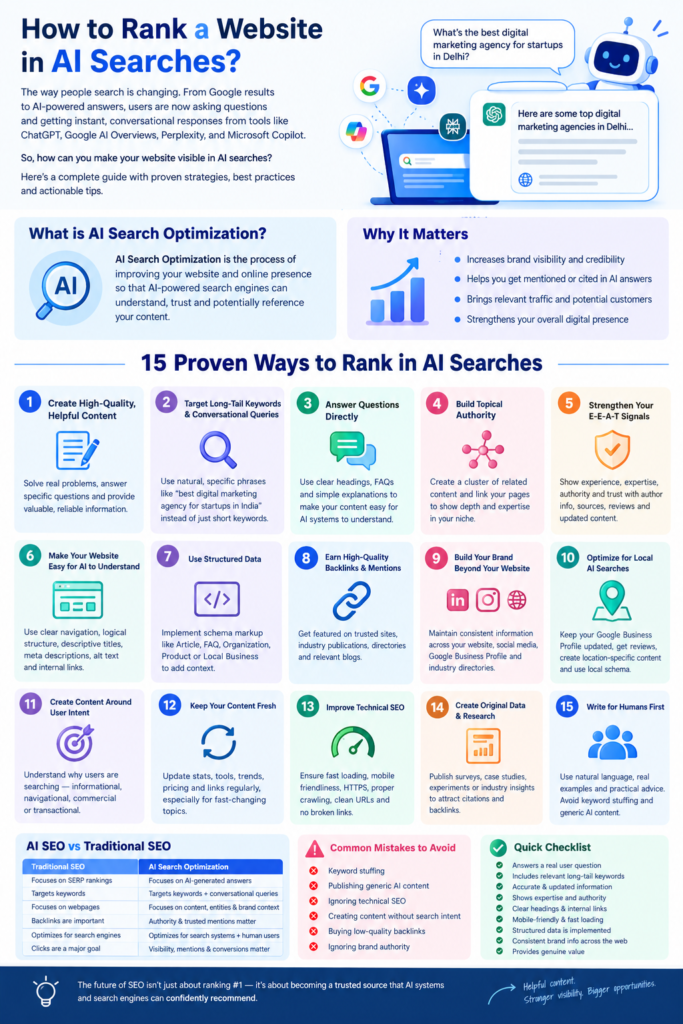
Search is changing rapidly. People are no longer relying only on traditional Google results to find answers. They are increasingly using AI-powered search experiences such as ChatGPT, Google AI Overviews, Microsoft Copilot, Perplexity, and other AI assistants to discover information, products, and services.
This creates a new opportunity for businesses: getting their website mentioned, recommended, or cited in AI-generated answers.
But ranking in AI searches is different from traditional SEO. While factors such as keywords, backlinks, technical SEO, and content quality still matter, AI search also focuses heavily on context, credibility, relevance, clear information, and user intent.
So, how can you make your website more visible in AI searches?
Let’s explore the strategies that can help.
What Is AI Search Optimization?
AI Search Optimization is the process of improving your website and online presence so that AI-powered search engines and answer engines can understand, trust, and potentially reference your content.
Traditional SEO primarily focuses on improving rankings in search engine results pages (SERPs).
AI search optimization goes a step further. The goal is to make your brand and content easy for AI systems to understand and confidently use when generating answers.
For example, instead of searching:
“Best digital marketing agencies in Delhi”
a user might ask an AI assistant:
“Which digital marketing agency in Delhi is best for a startup with a limited budget?”
The AI needs to understand the user’s intent, evaluate available information, and generate a useful response.
This means your website needs to provide more than keywords. It needs to provide clear, reliable, useful, and context-rich information.
Why Ranking in AI Searches Matters
AI search is becoming an important part of the modern search journey.
A user may discover your business through:
- An AI-generated recommendation
- A citation or reference
- A conversational answer
- A comparison generated by an AI tool
- A summary of your website
- Brand mentions across multiple sources
Even when users don’t click immediately, being mentioned by an AI system can increase brand awareness and credibility.
For businesses, this makes optimizing a website for AI search results an increasingly important part of a modern SEO strategy.
How to Rank a Website in AI Searches
1. Create High-Quality, Helpful Content
The foundation of AI search optimization is still great content.
AI systems need reliable information to generate useful answers. If your website contains thin, repetitive, or poorly researched content, it becomes harder for search systems to consider it a valuable source.
Instead, create content that genuinely solves your audience’s problems.
For example, instead of writing a generic article about digital marketing, create content around specific questions such as:
- How much does digital marketing cost for a small business?
- How can a startup generate leads through digital marketing?
- What are the best digital marketing strategies for local businesses?
- How does AI improve digital marketing campaigns?
These topics provide specific answers to specific user intents.
Tip:
Before writing an article, ask:
“Would this content actually help someone make a decision or solve a problem?”
If the answer is yes, you’re moving in the right direction.
2. Target Long-Tail Keywords and Conversational Queries
AI searches are often more conversational than traditional searches.
Instead of targeting only short keywords such as:
“Digital marketing agency”
you should also target long-tail keywords such as:
- how to choose the best digital marketing agency for a small business
- best digital marketing agency for startups in India
- how much does a digital marketing agency cost in India
- digital marketing strategies for small businesses
- how to improve website visibility in AI search results
- how to optimize content for ChatGPT search
- how to rank a website in AI-powered search engines
These longer phrases help you target users with a clearer search intent.
However, avoid forcing keywords into every paragraph. Natural language is more important than keyword density.
3. Answer Questions Directly
One of the simplest ways to make your content AI-friendly is to answer questions clearly.
Use headings based on the questions your audience is actually asking.
For example:
What Is AI SEO?
Give a short and direct answer immediately below the heading.
How Does AI Search Work?
Explain the concept in simple language.
How Can I Optimize My Website for AI Search?
Provide actionable steps.
This structure makes your content easier for both people and search systems to understand.
4. Build Topical Authority
Publishing one article about a topic isn’t enough to establish strong topical relevance.
Suppose your website focuses on digital marketing.
Instead of publishing one general article, create a group of related content covering:
- SEO
- AI SEO
- Content marketing
- Social media marketing
- Performance marketing
- Local SEO
- Email marketing
- Marketing analytics
- AI marketing tools
You can then internally link these articles to one another.
This creates a topic cluster and helps search engines understand what your website is knowledgeable about.
Example:
Pillar page:
Digital Marketing Guide
Supporting content:
- SEO for beginners
- AI SEO strategies
- Local SEO guide
- Digital marketing for startups
- Performance marketing guide
- Content marketing strategies
Together, these pages create stronger topical coverage than isolated articles.
5. Strengthen Your E-E-A-T Signals
Trust matters enormously in search.
Google’s quality guidelines emphasize Experience, Expertise, Authoritativeness, and Trustworthiness (E-E-A-T) as important concepts for evaluating content quality.
You can strengthen these signals by:
- Adding author information
- Showing relevant professional experience
- Providing accurate sources
- Keeping information updated
- Publishing original research
- Adding company information
- Displaying genuine reviews and testimonials
- Maintaining a professional About Us page
- Providing clear contact information
If your website makes claims, support them with credible evidence wherever appropriate.
6. Make Your Website Easy for AI to Understand
AI systems need to interpret your website’s content.
A confusing website structure can make this harder.
Make sure your website has:
- Clear navigation
- Descriptive headings
- Logical page structures
- Short and readable paragraphs
- Relevant internal links
- Descriptive page titles
- Useful meta descriptions
- Proper image alt text
- Structured data where appropriate
Avoid hiding important information behind unnecessary scripts or complicated interfaces.
Your website should be understandable to both humans and machines.
7. Use Structured Data
Structured data helps search engines understand the meaning and context of your content.
Depending on your website, relevant schema types may include:
- Article
- Organization
- Local Business
- Product
- Service
- FAQ
- Review
- Breadcrumb
For example, Organization structured data can help communicate information about your company.
However, structured data isn’t a shortcut to AI visibility. It should accurately represent the content already available on your page.
8. Earn High-Quality Backlinks and Brand Mentions
Backlinks remain an important part of SEO.
But don’t focus on collecting hundreds of low-quality links.
Instead, aim to earn mentions from relevant and trustworthy websites.
For example, a digital marketing company could build authority through:
- Industry publications
- Business directories
- Expert interviews
- Guest contributions
- LinkedIn articles
- Digital marketing communities
- Relevant blogs
- Case studies
- PR coverage
The bigger objective is to establish your brand as a recognizable and trustworthy entity within your industry.
9. Build Your Brand Beyond Your Website
AI search visibility isn’t necessarily limited to your own website.
AI systems can encounter information about your brand across the web.
Therefore, maintain consistent information across:
- Your website
- Business profiles
- Industry directories
- Review platforms
- Social media
- Relevant publications
Make sure your company name, services, descriptions, and other important information are consistent.
The more credible information exists about your brand across relevant sources, the easier it can be for search systems to understand your business.
10. Optimize for Local AI Searches
If you operate a local business, don’t ignore local search.
People may ask AI assistants questions such as:
“What is the best digital marketing agency near me?”
or
“Recommend a digital marketing agency in Delhi for a small business.”
To improve your chances of appearing in relevant local searches:
- Maintain an accurate Google Business Profile
- Keep your business information consistent
- Collect genuine customer reviews
- Create location-specific content
- Build relevant local backlinks
- Include your service areas on your website
- Use appropriate local business structured data
Local authority can become particularly important when AI systems are generating location-based recommendations.
11. Create Content Around User Intent
Keyword targeting alone isn’t enough.
You need to understand why someone is searching.
There are generally four major types of search intent:
Informational Intent
The user wants to learn something.
Example:
“What is AI SEO?”
Navigational Intent
The user wants to find a specific website or brand.
Example:
“Freelantics digital marketing services”
Commercial Intent
The user is researching before making a purchase.
Example:
“Best digital marketing agency for startups”
Transactional Intent
The user is ready to take action.
Example:
“Hire a digital marketing agency in Delhi”
Creating content for different stages of the customer journey can increase your overall search visibility.
12. Keep Your Content Fresh
AI search and traditional search both benefit from accurate, updated information.
Review your important pages regularly.
Update:
- Statistics
- Examples
- Pricing information
- Industry trends
- Screenshots
- Tools
- Links
- Outdated recommendations
For example, an article titled “Best AI Marketing Tools in 2026” should not continue recommending tools that are outdated or discontinued.
Freshness is especially important for topics where information changes quickly.
13. Improve Your Website’s Technical SEO
Content quality won’t reach its full potential if your website provides a poor technical experience.
Focus on:
- Mobile responsiveness
- Fast loading speed
- Core Web Vitals
- HTTPS
- Crawlability
- Indexability
- XML sitemap
- Clean URL structure
- Proper canonical tags
- Broken-link management
Technical SEO isn’t specifically an “AI ranking trick.” Instead, it creates a strong foundation that allows search engines to crawl, understand, and access your content effectively.
14. Create Original Data and Research
One powerful way to stand out is by publishing information that other websites don’t have.
For example, you could publish:
- Industry surveys
- Original statistics
- Customer research
- Marketing experiments
- Case studies
- Data-driven reports
- Expert interviews
Original information has the potential to attract citations and backlinks from other websites.
This can strengthen your overall authority and make your brand a more useful source of information.
15. Write for Humans First
This is perhaps the most important rule.
Don’t create content simply because you think an AI system will rank it.
Write content that people actually want to read.
Use:
- Natural language
- Short paragraphs
- Real examples
- Clear explanations
- Helpful visuals
- Practical advice
- Original insights
Avoid:
- Keyword stuffing
- Generic AI-generated filler
- Repetitive paragraphs
- Fake statistics
- Misleading claims
- Excessive headings without useful information
The best AI-search strategy is ultimately a human-first content strategy.
AI SEO vs Traditional SEO
| Traditional SEO | AI Search Optimization |
|---|---|
| Focuses heavily on SERP rankings | Focuses on visibility within AI-generated answers |
| Targets keywords | Targets keywords + conversational questions |
| Focuses on webpages | Focuses on content, entities, sources and brand context |
| Backlinks are important | Authority and trusted mentions remain important |
| Optimizes for search engines | Optimizes for search systems and human users |
| Clicks are a major goal | Visibility, mentions, citations and conversions can all matter |
It’s important to understand that AI SEO does not replace traditional SEO.
Instead, it expands SEO into a broader search ecosystem.
Common Mistakes to Avoid in AI Search Optimization
1. Keyword Stuffing
Repeating the same keyword unnaturally can make content difficult to read.
2. Publishing Generic AI Content
AI-generated content without original research, experience, or useful insights can add little value.
3. Ignoring Technical SEO
Great content still needs to be accessible to search engines.
4. Creating Content Without Search Intent
A page can target a keyword and still fail to answer what the user actually wants.
5. Buying Low-Quality Backlinks
Focus on relevance and authority rather than backlink quantity.
6. Ignoring Brand Authority
AI search visibility isn’t only about individual pages. Your broader online presence matters too.
How Long Does It Take to Rank in AI Searches?
There is no guaranteed timeline for appearing in AI-generated answers.
Visibility can depend on factors such as:
- Website authority
- Content quality
- Competition
- Search intent
- Industry
- Backlink profile
- Brand mentions
- Technical SEO
- Content freshness
Therefore, businesses should treat AI search optimization as a long-term strategy rather than a quick ranking hack.
AI Search Optimization Checklist
Before publishing your next article, check:
☑ Does the content answer a real user question?
☑ Have you naturally included relevant long-tail keywords?
☑ Is the information accurate and current?
☑ Does the article demonstrate expertise?
☑ Are headings and subheadings clear?
☑ Are important pages internally linked?
☑ Is the website mobile-friendly?
☑ Is the page technically accessible to search engines?
☑ Is structured data relevant and correctly implemented?
☑ Can users easily understand who created the content?
☑ Does your brand have consistent information across the web?
☑ Does the content provide something genuinely useful?
Final Thoughts
Ranking a website in AI searches isn’t about finding one secret AI SEO trick. It’s about building a website that search systems can understand and users can trust.
Focus on helpful content, conversational search queries, long-tail keywords, topical authority, technical SEO, structured data, backlinks, brand mentions, and strong E-E-A-T signals.
Most importantly, don’t write for algorithms alone. Write for people.
As search continues moving from traditional lists of links toward conversational answers, businesses that build genuine expertise and strong digital authority will be better positioned to compete.
The future of SEO isn’t just about ranking #1 on a search results page—it’s about becoming a trusted source that search engines and AI systems can confidently recommend.