How to Rank a Website in AI Searches: A Complete Guide for 2026
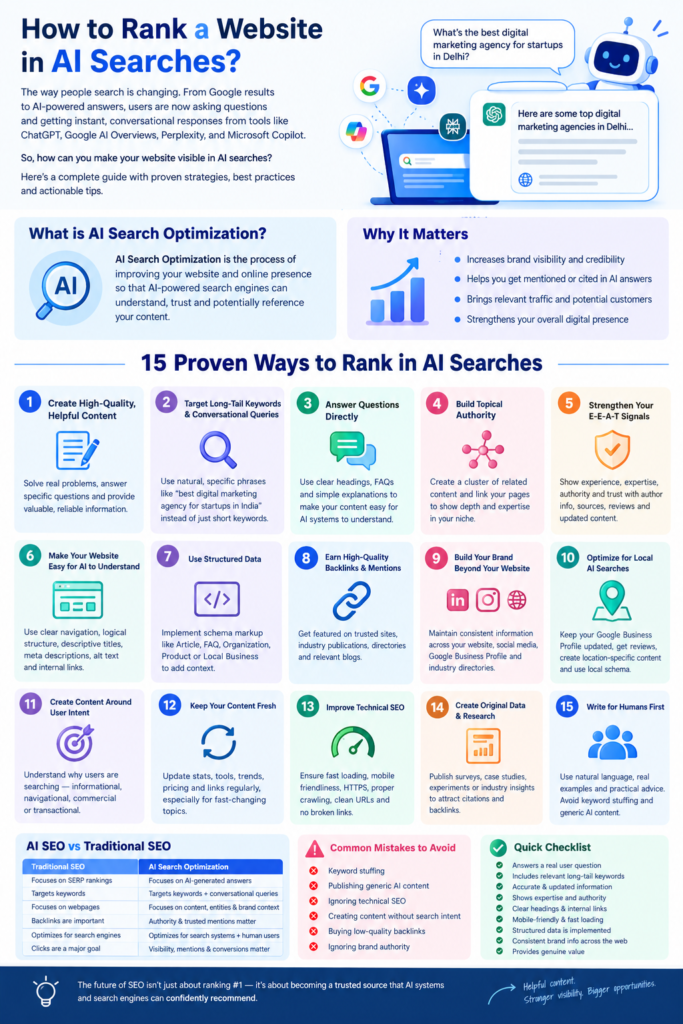
Search is changing rapidly. People are no longer relying only on traditional Google results to find answers. They are increasingly using AI-powered search experiences such as ChatGPT, Google AI Overviews, Microsoft Copilot, Perplexity, and other AI assistants to discover information, products, and services. This creates a new opportunity for businesses: getting their website mentioned, recommended, or cited in AI-generated answers. But ranking in AI searches is different from traditional SEO. While factors such as keywords, backlinks, technical SEO, and content quality still matter, AI search also focuses heavily on context, credibility, relevance, clear information, and user intent. So, how can you make your website more visible in AI searches? Let’s explore the strategies that can help. What Is AI Search Optimization? AI Search Optimization is the process of improving your website and online presence so that AI-powered search engines and answer engines can understand, trust, and potentially reference your content. Traditional SEO primarily focuses on improving rankings in search engine results pages (SERPs). AI search optimization goes a step further. The goal is to make your brand and content easy for AI systems to understand and confidently use when generating answers. For example, instead of searching: “Best digital marketing agencies in Delhi” a user might ask an AI assistant: “Which digital marketing agency in Delhi is best for a startup with a limited budget?” The AI needs to understand the user’s intent, evaluate available information, and generate a useful response. This means your website needs to provide more than keywords. It needs to provide clear, reliable, useful, and context-rich information. Why Ranking in AI Searches Matters AI search is becoming an important part of the modern search journey. A user may discover your business through: Even when users don’t click immediately, being mentioned by an AI system can increase brand awareness and credibility. For businesses, this makes optimizing a website for AI search results an increasingly important part of a modern SEO strategy. How to Rank a Website in AI Searches 1. Create High-Quality, Helpful Content The foundation of AI search optimization is still great content. AI systems need reliable information to generate useful answers. If your website contains thin, repetitive, or poorly researched content, it becomes harder for search systems to consider it a valuable source. Instead, create content that genuinely solves your audience’s problems. For example, instead of writing a generic article about digital marketing, create content around specific questions such as: These topics provide specific answers to specific user intents. Tip: Before writing an article, ask: “Would this content actually help someone make a decision or solve a problem?” If the answer is yes, you’re moving in the right direction. 2. Target Long-Tail Keywords and Conversational Queries AI searches are often more conversational than traditional searches. Instead of targeting only short keywords such as: “Digital marketing agency” you should also target long-tail keywords such as: These longer phrases help you target users with a clearer search intent. However, avoid forcing keywords into every paragraph. Natural language is more important than keyword density. 3. Answer Questions Directly One of the simplest ways to make your content AI-friendly is to answer questions clearly. Use headings based on the questions your audience is actually asking. For example: What Is AI SEO? Give a short and direct answer immediately below the heading. How Does AI Search Work? Explain the concept in simple language. How Can I Optimize My Website for AI Search? Provide actionable steps. This structure makes your content easier for both people and search systems to understand. 4. Build Topical Authority Publishing one article about a topic isn’t enough to establish strong topical relevance. Suppose your website focuses on digital marketing. Instead of publishing one general article, create a group of related content covering: You can then internally link these articles to one another. This creates a topic cluster and helps search engines understand what your website is knowledgeable about. Example: Pillar page:Digital Marketing Guide Supporting content: Together, these pages create stronger topical coverage than isolated articles. 5. Strengthen Your E-E-A-T Signals Trust matters enormously in search. Google’s quality guidelines emphasize Experience, Expertise, Authoritativeness, and Trustworthiness (E-E-A-T) as important concepts for evaluating content quality. You can strengthen these signals by: If your website makes claims, support them with credible evidence wherever appropriate. 6. Make Your Website Easy for AI to Understand AI systems need to interpret your website’s content. A confusing website structure can make this harder. Make sure your website has: Avoid hiding important information behind unnecessary scripts or complicated interfaces. Your website should be understandable to both humans and machines. 7. Use Structured Data Structured data helps search engines understand the meaning and context of your content. Depending on your website, relevant schema types may include: For example, Organization structured data can help communicate information about your company. However, structured data isn’t a shortcut to AI visibility. It should accurately represent the content already available on your page. 8. Earn High-Quality Backlinks and Brand Mentions Backlinks remain an important part of SEO. But don’t focus on collecting hundreds of low-quality links. Instead, aim to earn mentions from relevant and trustworthy websites. For example, a digital marketing company could build authority through: The bigger objective is to establish your brand as a recognizable and trustworthy entity within your industry. 9. Build Your Brand Beyond Your Website AI search visibility isn’t necessarily limited to your own website. AI systems can encounter information about your brand across the web. Therefore, maintain consistent information across: Make sure your company name, services, descriptions, and other important information are consistent. The more credible information exists about your brand across relevant sources, the easier it can be for search systems to understand your business. 10. Optimize for Local AI Searches If you operate a local business, don’t ignore local search. People may ask AI assistants questions such as: “What is the best digital marketing agency near me?” or “Recommend a digital marketing agency in Delhi for a small business.” To improve your chances
How to Rank a Website in AI Searches: A Complete Guide for 2026 Read More »